

A boarding decision is made in person. So the campaign stopped selling the school and started selling the drive.
HIE operates a 115-acre residential campus in Vikarabad, Telangana, roughly 70 km from Hyderabad, and two institutions share it. The CBSE school teaches Grades 1 to 10 as a day school, with a boys residential option from Grade 5 onward. The junior college runs a boys residential Intermediate programme with integrated coaching for engineering, medical, law and defence entrances.
Both divisions compete in crowded markets, and they compete against different opponents. The junior college sits across the table from Sri Chaitanya and Narayana, chains with a branch in every neighbourhood and newspaper advertisements full of state ranks. The school sits across from established premium residential CBSE institutions with decades of name recognition in Hyderabad. Neither division was going to win on scale or on legacy.
What HIE had was the campus itself. 115 acres, small batches, faculty who know students by name, integrated coaching under one roof and a boarding operation that a parent could inspect in person. That is also where the commercial problem began.
A residential admission is decided in person. Parents want to walk the grounds, see the dormitory, meet the warden, look at the kitchen and talk to the faculty before they commit a child to living away from home for two to six years. So the real currency of this programme was never the form fill. It was the campus visit.
And a campus visit is a serious ask. A 140 km round trip, most of a Saturday, usually both parents and often the child. An enquiry that waited a day for a reply was an enquiry that rarely became a visit. The question was how to get a parent to make that drive, and then turn the visit into a confirmed admission, across two divisions with entirely different buyers.
TWO DIVISIONS, TWO DIFFERENT PARENTS
HIE Junior College.
A two-year decision made quickly, usually in the weeks after Grade 10 results. The competitive set is the corporate coaching chains, so the messaging centred on board and entrance preparation integrated under one roof, smaller batches, and a campus where a boy is supervised rather than living near a coaching branch.HIE School, Residential.
A six-year decision with a far higher emotional barrier. The first question a parent asks is not about academics. It is whether a 10-year-old will be looked after. Messaging led with safety, supervision, food, housemasters and daily routine, and placed academics second.HIE School, Day.
A local catchment decision driven by proximity, CBSE curriculum and teaching quality. This audience was separated in targeting so that residential budget was never spent on families who only ever wanted a day place.

FOUR PARENTS, FOUR CONVERSATIONS
The Hyderabad mother.
She researches thoroughly, reads everything available and weighs her son's wellbeing as heavily as his rank. Reached through feed and reel placements carrying parent testimonials and campus footage.The district father.
He wants his son to have a real chance at an engineering or medical seat that the local college cannot offer. He decides quickly and responds to a clear structure and visible results.The Gulf NRI parent.
Working abroad and looking for an Indian education with strong values and close supervision. Separate campaigns addressed guardianship, parent communication and campus safety.The parent of an average student.
The largest underserved group in this market. Corporate colleges advertise their top rankers, and this parent knows their child will not be on that hoarding. The messaging focused on HIE lifting each student from where he currently stands, through small batches, continuous testing and attention to fundamentals.
AWARENESS, ENQUIRY, VISIT
Layer one, awareness.
Video and reel campaigns across Telangana and Andhra Pradesh introduced the campus ahead of the admissions season. These delivered 272,110 video thruplays, so that when an enquiry advertisement appeared later, it was meeting a parent who had already seen the grounds.Layer two, enquiry.
Instant forms and website lead campaigns, split by division and by stream. Instant forms carried the volume at the lowest cost, returning 1,486 leads at an average of ₹175 each. The best single college form campaign reached ₹32 per lead.Layer three, visit.
Retargeting and WhatsApp campaigns built around one action: booking a campus visit. Warm leads were segmented by stream for the college, MPC, BPC and MEC, and by grade and boarding preference for the school, then messaged with templates written for that specific parent. Open days and campus events ran as campaigns in their own right.

LET THE PARENTS TALK
Parents on camera.
The testimonial films did the one thing an advertisement cannot, which is to let a hesitant parent hear the answer from someone who has already made the same decision. These carried the residential campaigns, where the emotional barrier is highest.The campus as the proof.
115 acres is hard to describe and easy to show. Reels and video campaigns walked parents through the grounds, classrooms, dormitories, dining hall, sports facilities and laboratories, with the single objective of making the drive feel worth taking.Structure, explained plainly.
For the college, creative explained how board syllabus and entrance coaching sit on one timetable, how testing runs through the year, and how a student who is behind is brought up to the level of the batch.
ONE JOURNEY PER DIVISION
What exactly is this institution?
Division, board, grades, day or residential, and the streams available.Who will look after my child?
Faculty, wardens, supervision, infirmary and the shape of a normal day on campus.What does it cost, and what is included?
The fee structure set out clearly, including what boarding, lodging, infirmary, laundry and laboratory charges cover, so that no parent arrived on campus with the wrong expectation.How do I see it for myself?
A campus visit booking as the primary action on the page, with WhatsApp as the alternative for parents who prefer to ask a question first.

AN ANSWER IN SECONDS, AT ANY HOUR
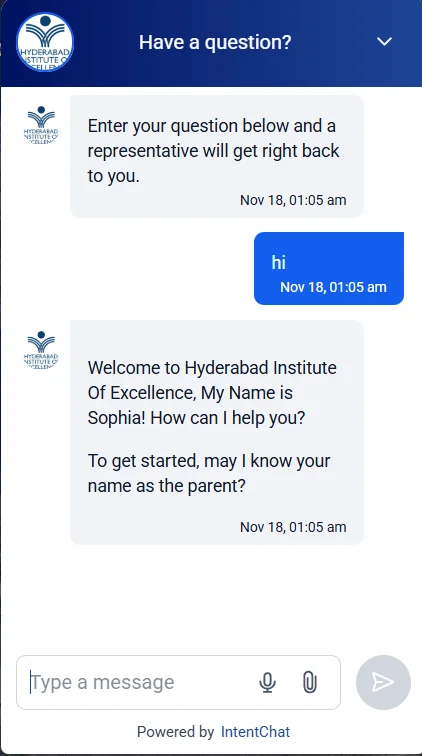
Instant acknowledgement.
The parent heard back within seconds, with confirmation and the information most parents ask for next.AI agents on the routine questions.
Fees by grade and stream, what the fee covers, grades offered, residential eligibility, distance and directions, open day dates and the documents required were all answered directly.Qualification before handover.
The agent established division, grade or stream, boarding preference and city before a human joined, so the admissions officer opened every conversation already knowing who they were speaking to.One objective in every conversation.
Book the campus visit.
ONE RECORD PER PARENT, AND A TASK ATTACHED TO IT
The record.
Source campaign, division and grade or stream, boarding preference, city, every message exchanged, every call outcome, visit status and registration status. The stages mirrored the real admissions journey rather than a generic sales pipeline: new enquiry, contacted, interested, visit booked, visited, registered, admitted.The sequences.
A nurture track for every stage, written separately for the school and the college, because a parent weighing boarding for a 10-year-old needs different reassurance from a parent choosing a stream for a 16-year-old. Just enquired. Interested but not yet booked. Visit booked, with directions, what to expect and a reminder the day before that lifted attendance. Visited but not yet registered. Registered but not yet admitted. And not this year, kept warm for the following cycle rather than discarded.The tasks.
Automation answers, people close. A new qualified enquiry created a call task routed to the right officer by division. A booked visit created confirmation and preparation tasks plus a reminder call the day before. A completed visit created a follow-up within 24 hours. A parent who replied to any sequence moved to the front of the queue. A task left unworked escalated rather than expiring quietly.
| Metric | Dec 2025 to Nov 2026 |
|---|---|
| Media investment | ₹1,515,003 |
| Advertising impressions | 20,145,882 |
| People reached | 5,820,380 |
| Video thruplays | 272,110 |
| Clicks to landing pages | 717,156 |
| Landing page views | 99,003 |
| Parent enquiries logged, school division | 2,610 |
| WhatsApp conversations started | 261 |
| Campus visits completed | 355 |
| Admissions confirmed | 153 |
| Visit to admission rate | 43.1% |
| Cost per campus visit | ₹4,268 |
| Cost per admission | ₹9,902 |
| First-year fee value of confirmed admissions | ₹44.7 million |
| Media investment as a share of enrolled fee value | 3.4% |
| Metric | CBSE School | Junior College | Total |
|---|---|---|---|
| Media investment | ₹854,956 | ₹660,047 | ₹1,515,003 |
| Campus visits | 147 | 208 | 355 |
| Admissions | 58 | 95 | 153 |
| Visit to admission | 39.5% | 45.7% | 43.1% |
| Cost per admission | ₹14,741 | ₹6,948 | ₹9,902 |
| First-year fee value | ₹13.9 million | ₹30.7 million | ₹44.7 million |
A cost per lead will not tell you whether the campus is filling.
BUILD THE ADMISSIONS SYSTEMRESPONSE WITHIN ONE BUSINESS DAY